Experience the History of Lake Hartwell Country
Though we’re several months past the 4th of July, we’re still in the midst of America’s 250th anniversary: a year of commemoration, history, and legacy. Lake Hartwell Country, our tourism region that comprises South Carolina’s Anderson, Oconee, and Pickens counties, has a storied history of its own. Read on to learn more about Lake Hartwell Country’s history and find destinations where you can experience the past firsthand.

Lake Hartwell Country’s Indigenous Inhabitants
Long before South Carolina was settled by Europeans and became one of the original 13 colonies, our area was inhabited by Native Americans, particularly the Cherokee. Their legacy can be seen in many location names, including Oconee (“Land Beside the Water”), Keowee (“Place of the Mulberry Patch”), and Tamassee (“Place of the Sunlight of God”).
The Cherokee were based in seven Lower Towns across Upstate South Carolina, creating a strong network for trade, communication, and protection. However, when European settlers began to arrive, alliances formed and shifted rapidly. Most of the Lower Town Cherokee allied with the British in the French and Indian War before that partnership fell apart and British leaders razed Keowee. Despite these attacks, some Cherokee once again allied with the British during the American Revolution and fought against the American militia.
Here are some of the best places to learn about Lake Hartwell Country’s original inhabitants:
Cherokee Boundary Historical Marker: During and after the Revolutionary War, many of the Cherokee were forced out of their ancestral lands. This marker commemorates one such boundary as they were pushed further west.
Museum of the Cherokee in South Carolina: Walhalla has several museums that commemorate the region’s history, including this one specifically dedicated to the Cherokee.
Oconee History Museum: Just down the street in Walhalla sits the Oconee History Museum, offering a wealth of information about the county. From pre-Revolutionary Cherokee history through more recent developments, its artifacts tell a riveting story.
Oconee Station State Historic Site: This historic site served many purposes during its time on America’s westernmost frontier, including both as a trading post to meet peacefully with Cherokee merchants and a defensive outpost to protect local settlers from raids.
Tamassee Town (Ring Fight) Historical Marker: This historical marker commemorates the 1776 battle at the Lower Town of Tamassee, fought between the Cherokee and Captain Andrew Pickens’ militia.

Lake Hartwell Country in the Revolutionary War
Despite popular histories of the American Revolution focusing heavily on the New England colonies and mid-Eastern Seaboard, the Southern Theater of war helped contribute to the ultimate American victory. By 1778, the British began to re-concentrate their forces on Southern states, including South Carolina.
In 1780, British troops captured Charleston and Camden; however, more rugged, backcountry battles here in the Upstate region proved to be underdog colonial triumphs that demoralized the regulars and stretched their forces thin. The British made a pivotal surrender at the Battle of Yorktown in 1781, though skirmishes and conflicts remained ongoing until the Treaty of Paris officially ended the war in 1783.
Anderson, Oconee, and Pickens Counties contributed many soldiers and commanders to the American Revolutionary effort, and today you can still see their legacies across Lake Hartwell Country. Learn more about Lake Hartwell Country’s Revolutionary impact:
Anderson County Museum: Anderson’s free museum features several ways to engage with Revolutionary War history, including the “Old Reformer” cannon out front, believed to have been built in the 1760s, as well as their permanent “Andersonians in War” exhibit.
Old Pickens Cemetery: This historic cemetery is owned by Southern Wesleyan University and holds the remains of at least 23 Revolutionary War soldiers, including Captain Robert Pickens.
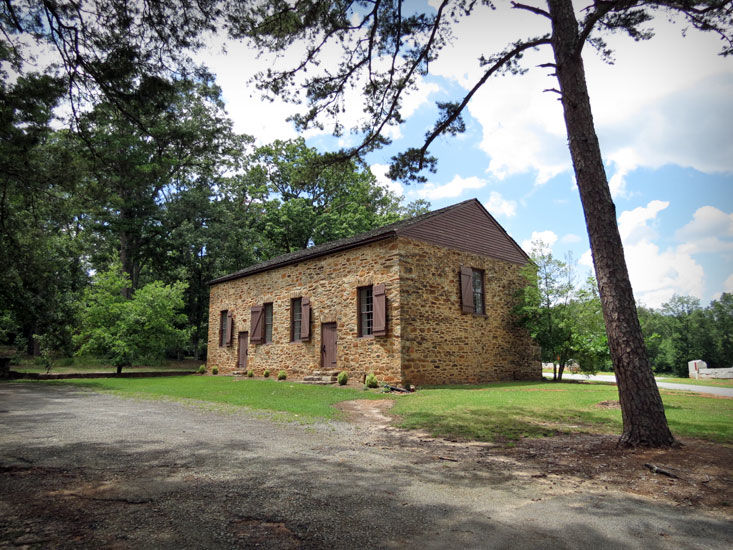
Old Stone Church: Clemson’s Old Stone Church was completed in 1802 and is the final resting place of Brigadier General Andrew Pickens and Colonel Robert Anderson, both of whom were crucial leaders in South Carolina’s Revolutionary War campaigns.
Daily Life & Labor in Lake Hartwell Country
After the initial period of settlement and between periods of conflict, life for many Lake Hartwell Country residents was a typical Southern tableau. While local planters and community leaders pushed forth developments in agricultural, education, and technology, many of these industries were sadly built on the backs of enslaved workers, typically African Americans.
Museums and historic sites across Lake Hartwell Country work to show the brutal reality of life on slaveholding plantations, an unfortunate component of South Carolina’s legacy. However, like all painful parts of history, it is important to learn from past injustices to ensure they are not repeated. Clemson University in particular takes care to maintain its historic homes and facilities, dating both before and after the Civil War.
However, not all history is so sobering: you can take a hands-on look at life as a farmer or browse local families’ genealogies to immerse yourself in what Lake Hartwell Country might have been like 50 or 100 years ago. Learn more about daily life in the region at this wide variety of informative sites:
Bart Garrison Agricultural Museum of South Carolina: A great family-friendly museum, this Pendleton-area attraction offers a variety of hands-on educational exhibits, classes, and workshops to teach guests about agriculture here in Lake Hartwell Country.
Central Railway Museum: Railroads became an important part of transportation and commerce as the 19th century progressed, and Lake Hartwell Country was at the crossroads of progress. Check out this unique museum for a look at an under-appreciated component of daily life in the past.
Clemson Area African American Museum (CAAAM): This museum highlights the legacy and contributions of African Americans in Clemson and Pickens County. Located on the site of the former Calhoun Colored School, it is the only museum in the county exclusively focused on African Americans’ history.
Generator Park: You may know that Anderson is nicknamed “The Electric City,” but do you know why? Local son William Whitner opened a hydroelectric plant outside of Anderson, making it one of the very first cities in the Southeast to be powered by electricity. This generator, and its park, tell the story of progress.

No matter if you’re a history buff or are simply curious about what forces shaped the society around us, there is so much to learn right here in Lake Hartwell Country. Take a trip to your local museum, pause to read the next historic marker you spot, or schedule an appointment to check out local artifacts and family trees. What will you discover?